This comprehensive guide details exactly how to build a resilient Content Strategy Framework from scratch. You will learn to execute deep audience research, establish authoritative content pillars, implement solid governance models, and optimize distribution to maximize visibility and drive high-quality leads consistently.
Creating content without a roadmap guarantees wasted resources. A Content Strategy Framework provides the exact blueprint you need to plan, create, distribute, and manage information that serves both your business objectives and your users’ needs. By aligning your publishing efforts with a structured approach, you stop guessing and start driving measurable growth. When you establish this foundation, every blog post, video, and whitepaper works together to build topical authority and trust.
Why You Need a Structured Approach
Publishing randomly leaves massive gaps in your customer journey. A solid Content Strategy Framework prevents these gaps by ensuring every piece of content maps to specific search intent and business goals. Companies that document their strategy see significantly higher ROI than those that wing it. You need a system that dictates who creates the content, why it exists, and how it reaches the right eyes. This requires meticulous planning across several core disciplines.
Deep-Dive Audience Research
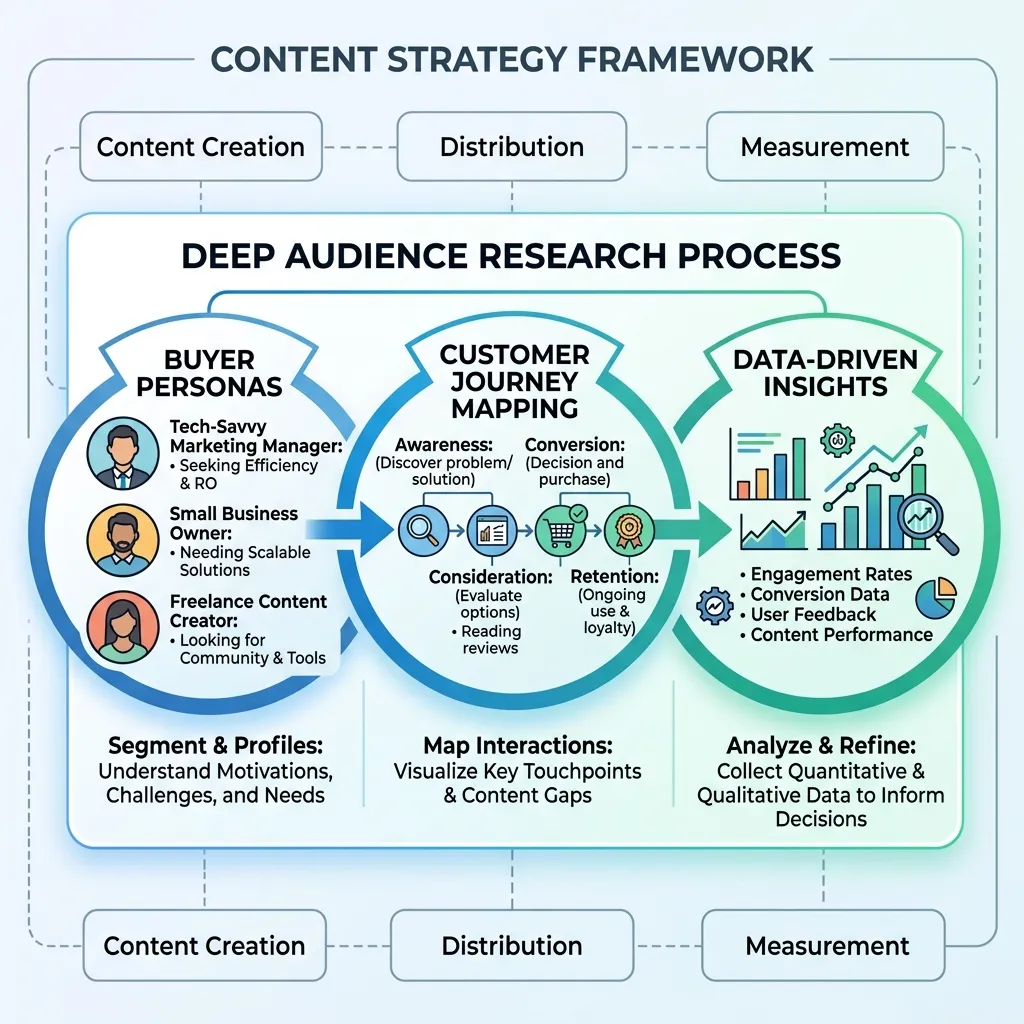
You cannot create valuable content if you do not know exactly who you are writing for. Deep audience research forms the bedrock of any successful Content Strategy Framework. You must move beyond basic demographics and uncover the psychological triggers, pain points, and specific questions your potential buyers have.
Building Data-Driven Buyer Personas
Creating accurate buyer personas requires quantitative and qualitative data. Relying on assumptions leads to content that misses the mark completely. You need to analyze your existing customer database, interview your best clients, and study how people interact with your current assets.
Look at the specific language your audience uses on forums, social media, and customer support tickets. When you mirror their exact phrasing, your content resonates instantly. Document their daily challenges, their technical proficiency, and their preferred distribution channels. Knowing whether your audience prefers long-form articles or short video tutorials dictates your entire production schedule.
Mapping the Customer Journey
Your audience requires different information depending on their stage in the buying cycle. A complete Content Strategy Framework maps specific topics to the awareness, consideration, and decision stages.
At the awareness stage, users search for broad educational content to define their problems. Consideration stage content must offer solutions and compare different approaches. Decision stage content requires case studies, pricing guides, and detailed product comparisons. If you only publish awareness-level blog posts, you will generate traffic but zero revenue. You must balance your editorial calendar to nurture users through the entire journey.
Keyword Strategy and Search Intent
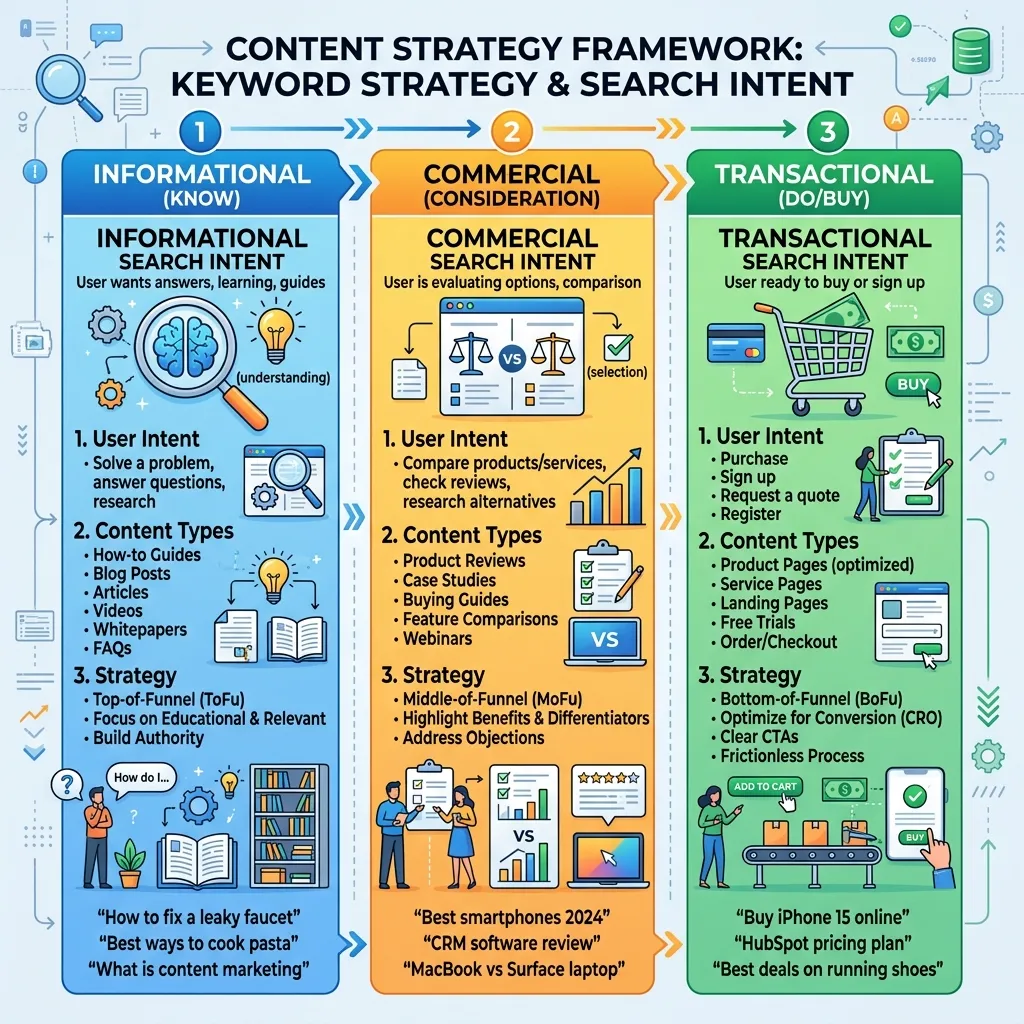
Your Content Strategy Framework relies heavily on intelligent keyword research to capture organic traffic. Finding keywords with high volume is not enough; you must understand exactly what the user wants to accomplish when they type that query into a search engine.
Decoding Search Intent
Search engines prioritize content that best satisfies the user’s ultimate goal. We classify search intent into four main categories: informational, navigational, commercial, and transactional.
If a user searches for a broad topic, they want an informational guide, not a sales pitch. If they search for software alternatives, they need commercial comparison content. Your Content Strategy Framework must categorize every target keyword by its intent and dictate the appropriate content format. Trying to rank a product page for an informational keyword will fail because it does not match what the searcher actually wants to see.
Semantic SEO and Entity Building
Modern search engine optimization focuses on concepts and entities rather than exact-match keyword stuffing. Search engines understand the relationships between different topics. To build authority, your Content Strategy Framework must include semantic variations and related questions.
When writing about email marketing, you must naturally cover related entities like open rates, spam filters, and automation workflows. This signals comprehensive expertise. Tools like Ahrefs or Semrush can help you identify these semantic relationships, ensuring your content covers the topic holistically.
Pro Tip: Always analyze the top five ranking pages for your target keyword. Note the subtopics they cover and ensure your content goes even deeper, providing original data or unique expert perspectives they missed.
Developing Core Content Pillars
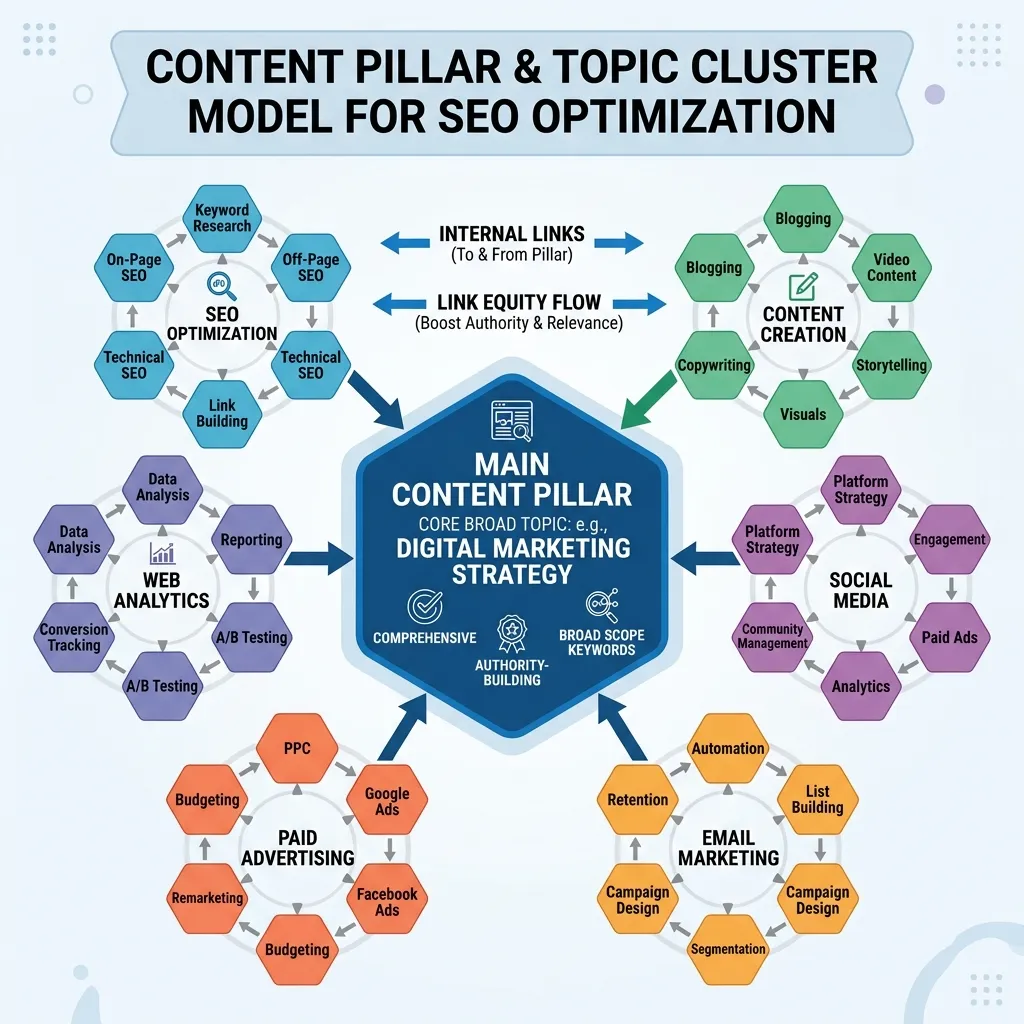
Content pillars provide structural integrity to your Content Strategy Framework. Instead of publishing disconnected articles, you group your content into tightly themed clusters. This organization helps search engines understand your site’s hierarchy and establishes you as a topical authority.
The Pillar and Cluster Model
A content pillar is a comprehensive, broad guide covering all aspects of a core topic. Cluster content consists of smaller, hyper-focused articles that drill down into specific subtopics mentioned in the pillar page. You then link all cluster articles back to the main pillar page, and the pillar page links out to the clusters.
This internal linking structure passes authority between pages. If one cluster article gains traction and earns external links, the entire pillar benefits. This model prevents topic cannibalization and ensures you cover your industry completely without overlapping your own efforts.
Selecting Your Pillar Topics
Choose pillar topics that directly align with your core products or services. If you sell accounting software, your pillars might include “Small Business Bookkeeping,” “Tax Preparation,” and “Payroll Management.” Ensure the topic is broad enough to support at least 15 to 20 cluster articles but specific enough to attract your target buyer persona.
|
Feature |
Content Pillar Page |
Topic Cluster Article |
|---|---|---|
|
Scope |
Broad, comprehensive overview |
Narrow, deep-dive into one subtopic |
|
Length |
Typically 2,000 to 5,000+ words |
Typically 800 to 1,500 words |
|
Target Keyword |
High-volume, high-competition head term |
Long-tail, lower-competition keyword |
|
Linking Strategy |
Links out to all related cluster pages |
Links back to the main pillar page |
Governance Models and Workflows

A Content Strategy Framework collapses quickly without strong content governance. Governance dictates how content is requested, created, reviewed, published, and eventually retired. It ensures brand consistency and legal compliance across all channels.
Defining Roles and Responsibilities
Ambiguity kills content production. You must clearly define who does what in your organization. A standard governance model includes several key roles:
- Strategist: Defines the overarching goals and topical direction.
- Subject Matter Expert (SME): Provides the raw knowledge, original insights, and technical accuracy.
- Writer/Creator: Transforms the SME’s knowledge into engaging, optimized formats.
- Editor: Ensures adherence to brand voice, grammar guidelines, and SEO requirements.
- Publisher: Handles the technical upload, formatting, and live deployment.
Without these defined roles, bottlenecks occur. Experts get stuck writing poor copy, or writers publish technically inaccurate information because nobody reviewed it.
The Content Lifecycle
Content requires ongoing maintenance. The Nielsen Norman Group emphasizes that strategy includes the entire lifecycle: planning, creation, maintenance, and unpublishing.
Set up a quarterly review process in your editorial calendar to evaluate existing assets. If a post generates steady traffic but has outdated statistics, update it immediately. If a post drives zero traffic and offers zero value, unpublish it and redirect the URL to a relevant pillar page. Pruning dead content significantly boosts your overall website authority.
Common Mistakes to Avoid:
- Ignoring existing assets: Creating new content while letting old posts rot damages your site quality.
- Siloed creation: Allowing different departments to publish without centralized oversight ruins brand consistency.
- Skipping the brief: Writing without a detailed content brief leads to scope creep and missed SEO targets.
Distribution and AEO/GEO Optimization
Creating the content is only half the battle. Your Content Strategy Framework must include a rigorous distribution plan to get your assets in front of your target audience. Furthermore, as search evolves, you must optimize for Answer Engine Optimization (AEO) and Generative Engine Optimization (GEO).
Multi-Channel Distribution Tactics
Do not rely solely on organic search. Distribute your content across email newsletters, industry forums, and social media platforms. Repurpose your long-form articles into bite-sized LinkedIn carousels, short-form videos, and engaging infographics.
To amplify your reach, actively pursue link-building. Reach out to industry publications like the Content Marketing Institute to secure guest posting opportunities or quote inclusions. Earning backlinks from high-authority domains remains a critical signal of trustworthiness and quality.
Optimizing for AI Search Engines
AI-driven search engines like ChatGPT and Google’s AI Overviews summarize information directly for the user. To ensure these AI search engines cite your content, you must optimize for extraction.
Structure your content logically using clear H2 and H3 tags. Provide direct, succinct answers to common questions immediately beneath the heading. Use bulleted lists and comparison tables to format data cleanly. When you present highly structured, factual information, AI models can easily parse and reference your work, increasing your overall search engine optimization success.
Conclusion
Implementing a robust Content Strategy Framework empowers your business to publish with purpose, dominate search rankings, and convert readers into buyers. By prioritizing audience research, intelligent keyword mapping, and strict governance, you build a sustainable asset library that drives long-term revenue.
Frequently Asked Questions
What is a Content Strategy Framework?
A Content Strategy Framework is a structured plan that guides the creation, delivery, and governance of useful, usable content to achieve specific business and user goals. It ensures all publishing efforts remain intentional and data-driven.
Why is audience research critical for content strategy success?
Audience research reveals the exact problems, questions, and language your potential customers use. Without it, you risk creating content that nobody searches for or cares about, wasting your marketing budget.
How do topic clusters improve SEO?
Topic clusters group related content together through strategic internal linking. This structure helps search engines understand your site’s hierarchy and establishes strong topical authority, which improves overall rankings for broad keywords.
What role does search intent play in content creation?
Search intent defines what the user actually wants to achieve with their query. Matching your content format and depth to their specific intent (informational, commercial, transactional) ensures you satisfy their needs and rank higher.
What is content governance?
Content governance involves the policies, workflows, and roles required to manage content effectively. It ensures consistency, quality, and legal compliance across the entire lifecycle, from ideation to eventual unpublishing.
How frequently should I update old content?
You should audit your content library at least quarterly. Update high-traffic posts with new data and fresh insights annually, and remove or consolidate low-performing assets to keep your website authoritative and relevant.
What is the difference between a content strategy and an editorial calendar?
The strategy dictates the “why” and “what” based on business goals and audience needs. The editorial calendar is simply the tactical execution tool that tracks the “when” and “who” for actual publishing.
How do I optimize my content for AI search engines?
Optimize for AI by providing clear, direct answers to specific questions, using highly structured formatting like bullet points and tables, and ensuring your information is factually accurate and deeply expert-driven.
Why is internal linking so important?
Internal linking distributes page authority throughout your website and helps users navigate related topics. It keeps visitors engaged longer and provides search crawlers with a clear map of your content pillars.
How do I measure the success of my content strategy framework?
Measure success by tracking metrics tied directly to your business goals. Monitor organic traffic growth, keyword ranking improvements, time on page, and most importantly, lead generation and conversion rates from your published assets.