
This guide covers the essentials of B2B content marketing, including strategy development, content types, benefits, and actionable tips, empowering you to build authority, generate leads, and drive business growth.
Want to turn competitors into loyal clients? Grasping what is b2b content marketing gives your business a powerful edge in today’s competitive landscape. By strategically developing and distributing valuable, relevant information, you attract key decision-makers and actively drive revenue growth. Instead of relying solely on traditional advertising techniques, this approach focuses on building relationships through education, insight, and trust. Business buyers need meaningful solutions to complex challenges, and B2B content marketing enables you to showcase expertise while nurturing prospects along every stage of the buying journey. Unlock sustainable results—and turn influence into conversions—by mastering these principles and proven tactics.
The Definition and Importance of B2B Content Marketing
To truly grasp what is b2b content marketing, you must look beyond basic advertising. It involves the strategic creation and distribution of valuable, relevant, and consistent material to attract and retain a clearly defined business audience. Instead of pushing a hard sales pitch, this approach focuses on educating prospects, solving their unique challenges, and guiding them toward a profitable purchasing decision.
Business-to-business transactions differ vastly from consumer purchases. They usually involve multiple decision-makers, higher price points, and significantly longer sales cycles. Buyers conduct extensive independent research before ever speaking to a sales representative. If your brand does not provide the answers they seek during this research phase, your competitors certainly will.
Providing high-quality information positions your company as a trusted industry authority. When buyers see that you deeply understand their pain points, they feel more confident investing in your solutions. This educational approach builds a foundation of credibility that traditional outbound marketing simply cannot achieve.
Furthermore, a robust B2B approach aligns marketing and sales teams around a unified message. Marketing creates the educational assets that sales representatives use to overcome objections and close deals. This synergy reduces friction in the buying journey and accelerates revenue growth across the entire organization.
Key Benefits of a Strategic Approach
Investing time and resources into a structured approach yields compounding returns over time. Unlike paid advertising that stops working the moment you turn off the budget, published assets continue working for your brand around the clock.
Building Unshakable Trust and Authority
Trust serves as the primary currency in business-to-business relationships. Corporate buyers risk their budgets and professional reputations when selecting new software, services, or equipment. According to research published by Forbes, buyers overwhelmingly prefer to work with vendors they view as reliable thought leaders. Publishing insightful whitepapers, detailed guides, and data-backed articles proves your expertise and reduces the perceived risk for the buyer.
Accelerating Lead Generation
Effective content acts as a magnet for high-quality prospects. By offering premium resources like templates, industry reports, or webinars in exchange for contact information, you fuel your lead generation engine. This process brings individuals into your ecosystem who actively want to hear from your brand. Over time, you can nurture these contacts through automated email sequences until they are ready to buy.
Enhancing SEO Optimization
Search engines prioritize websites that consistently publish highly relevant, authoritative information. Implementing proper SEO optimization ensures your brand appears at the exact moment a prospect searches for a solution to their problem. Earning top spots on search engine results pages drives a steady stream of organic traffic to your site, lowering your overall customer acquisition costs and increasing your brand’s digital footprint.
Nurturing Long Sales Cycles
Because corporate purchases take months or even years to finalize, you must stay top-of-mind throughout the entire process. Regularly delivering valuable insights keeps prospects engaged while they navigate internal approvals and budget discussions. Providing the right piece of information at the right time helps move a hesitant buyer from the consideration phase to the final decision phase.
Empowering Your Sales Team
Sales representatives spend countless hours answering the same questions and addressing identical objections. An organized library of resources allows your sales team to quickly share relevant case studies or comparison guides with prospects. This accelerates the sales process and ensures prospects receive consistent, accurate messaging regardless of who they speak with at your company.
Top Types of B2B Content
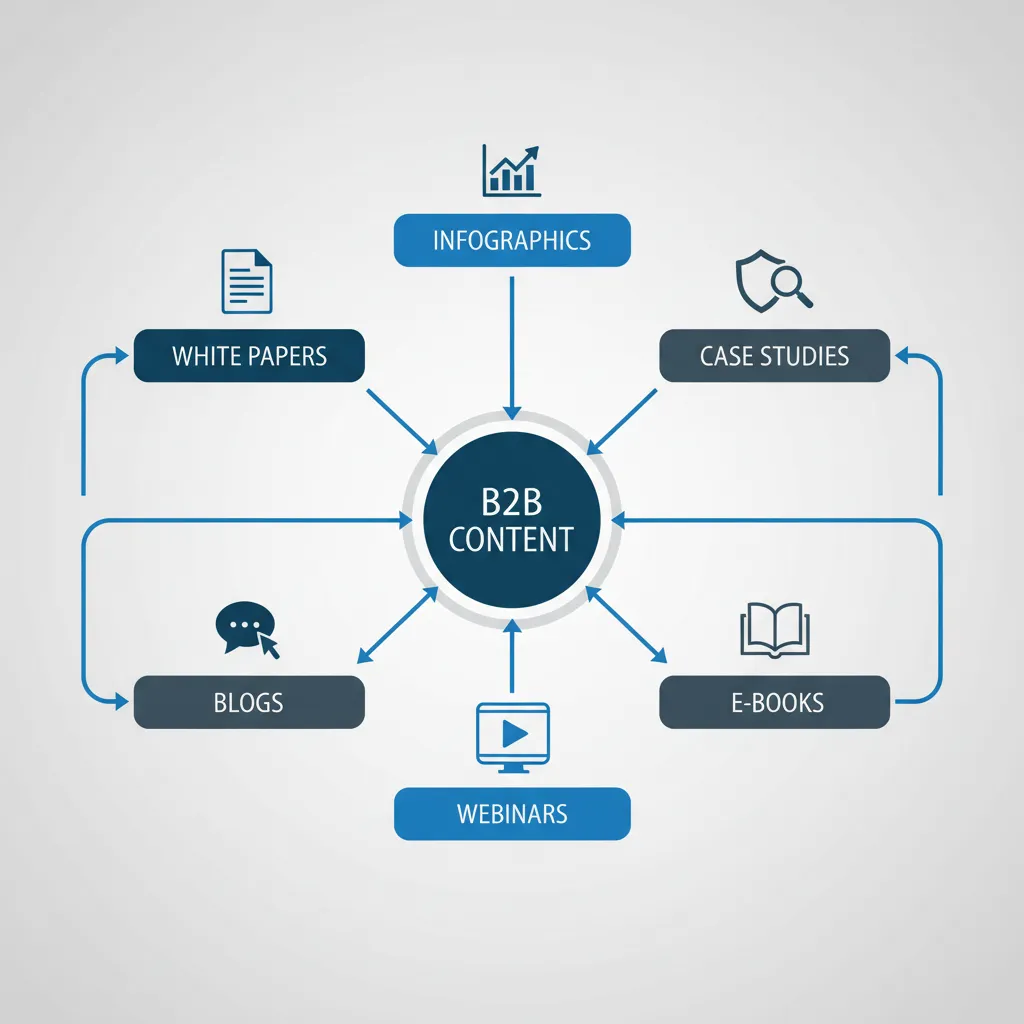
To reach buyers at every stage of their journey, you must diversify your formats. Different individuals prefer consuming information in different ways, and various formats serve distinct purposes within the marketing funnel.
Comprehensive Blog Posts
Blogs remain the foundation of most digital marketing efforts. They excel at capturing top-of-funnel awareness and driving organic traffic through targeted keywords. Successful B2B blogs go beyond surface-level advice. They dive deep into complex industry challenges, offer step-by-step solutions, and provide actionable takeaways that readers can implement immediately.
Data-Driven Case Studies
Nothing proves your value quite like a detailed success story from a satisfied client. Case studies sit at the bottom of the funnel, targeting prospects who are actively comparing vendors. These documents should follow a clear narrative arc: the client’s initial problem, the specific solution your company provided, and the measurable results achieved. Including concrete numbers and direct quotes maximizes their impact.
In-Depth Whitepapers and Reports
Whitepapers offer comprehensive explorations of specific industry problems and their technical solutions. They typically require significant research and authoritative data to back up their claims. Because of their high perceived value, whitepapers serve as excellent gated assets for capturing email addresses. Many organizations also publish annual industry reports featuring original research, which frequently attract backlinks from other publications.
Engaging Webinars
Webinars provide a unique opportunity to connect with your audience in real-time. They allow you to demonstrate complex products, host expert panel discussions, and answer audience questions directly. The interactive nature of a webinar builds rapport and humanizes your brand. Furthermore, you can record these sessions and offer them as on-demand resources long after the live event concludes.
Targeted Email Newsletters
Email remains one of the most reliable channels for business communication. A well-crafted newsletter allows you to bypass search engine algorithms and deliver insights directly to your audience’s inbox. Instead of constantly pitching your services, use your newsletter to curate industry news, share your latest blog posts, and provide exclusive tips that subscribers cannot find elsewhere.
Educational Video Content
Video continues to dominate digital consumption habits across all demographics. For business audiences, short explainer videos, software tutorials, and executive interviews simplify complex topics. Videos hold viewers’ attention longer than text and perform exceptionally well on professional networking platforms like LinkedIn.
Insightful Podcasts
Podcasts offer a highly convenient way for busy professionals to consume information while commuting or traveling. Hosting a podcast allows you to interview industry leaders, discuss emerging trends, and showcase your company’s personality. This audio format fosters a strong parasocial relationship with listeners, making them feel personally connected to your brand.
Steps to Create a Winning B2B Content Strategy
Creating materials randomly without a plan wastes time and resources. To achieve measurable business outcomes, you must build a documented content strategy that aligns with your overarching organizational goals.
Step 1: Define Your Buyer Personas
You cannot create resonant material if you do not know who you are talking to. Develop detailed buyer personas representing your ideal customers. Identify their job titles, daily responsibilities, primary challenges, and preferred information sources. Interview your current best customers to understand the exact questions they had before purchasing your product.
Step 2: Map the Buyer’s Journey
Corporate buyers pass through three distinct phases: awareness, consideration, and decision. Map specific topics and formats to each stage of this journey. For the awareness stage, focus on educational blog posts that define their problems. During the consideration stage, offer webinars and comparison guides. In the decision stage, provide case studies and technical documentation to validate their choice.
Step 3: Conduct a Content Audit
Before creating new assets, evaluate what you already have. Catalog your existing blog posts, videos, and guides. Analyze their performance using your web analytics platform. Identify pieces that generate high traffic but low conversions, and look for topics that your current library completely ignores. This audit prevents duplicate work and highlights immediate opportunities for improvement.
Step 4: Perform Strategic Keyword Research
To ensure your target audience actually finds your work, you must understand the exact phrases they type into search engines. Use SEO tools to identify relevant keywords with healthy search volume and manageable competition. Focus heavily on long-tail keywords—highly specific phrases that indicate strong purchasing intent. Group these keywords into thematic clusters to build comprehensive topic authority.
Step 5: Establish Clear Goals and KPIs
Determine exactly what you want your efforts to achieve. Do you want to increase overall website traffic, generate a specific number of qualified leads, or boost your email subscriber list? Tie these goals to specific Key Performance Indicators (KPIs) such as organic sessions, conversion rates, and bounce rates. Setting clear targets allows you to measure your return on investment accurately.
Step 6: Build an Editorial Calendar
Consistency separates successful brands from those that fail to gain traction. Create an editorial calendar that dictates exactly what you will publish, when you will publish it, and who is responsible for creating it. A centralized calendar keeps your marketing team accountable and ensures a steady stream of fresh material reaches your audience.
Step 7: Focus on Distribution
Creating a brilliant guide means nothing if nobody reads it. Dedicate as much time to distributing your assets as you do to creating them. Share your articles on LinkedIn, syndicate them on platforms like Medium, send them to your email list, and encourage your employees to share them with their networks. Consider allocating a small budget for paid promotion to guarantee your best pieces reach a highly targeted audience.
Step 8: Measure, Analyze, and Iterate
Digital marketing requires constant refinement. Review your KPIs monthly to see which topics and formats resonate most with your audience. If a particular type of post consistently drives high-quality leads, double down on that format. If a specific campaign underperforms, analyze the data to understand why and adjust your approach accordingly.
Common Mistakes to Avoid
Even experienced marketing teams occasionally stumble. Avoiding these common pitfalls will save your organization from wasting valuable budget on ineffective campaigns.
Focusing Too Much on Your Product
Corporate buyers care about their own problems, not your software features. A major mistake is treating every blog post or video as a thinly veiled sales pitch. If you constantly talk about yourself, readers will quickly lose interest and seek out more helpful resources. Focus on educating and assisting your audience first; introduce your product only when it naturally solves the problem you are discussing.
Ignoring Search Intent
Ranking for a high-volume keyword helps no one if the visitors immediately leave your site. This usually happens when your article fails to match the user’s search intent. Before writing, analyze the current top-ranking pages for your target keyword. If the search results show beginner-level definitions and you write an advanced technical manual, search engines will not rank your piece.
Producing Thin, Low-Quality Material
In an attempt to publish frequently, some companies resort to churning out short, generic articles that offer no real value. The Content Marketing Institute continually emphasizes that quality absolutely trumps quantity. A single, comprehensive, 2000-word guide that perfectly answers a buyer’s question will generate far more revenue than ten shallow 500-word posts.
Failing to Repurpose Assets
Creating original, in-depth assets takes massive amounts of time and energy. Publishing a whitepaper once and then forgetting about it represents a massive missed opportunity. Maximize your return on investment by breaking large assets down into smaller pieces. Turn a webinar into a blog post, extract statistics for social media graphics, and use video clips for LinkedIn updates.
Neglecting the Call-to-Action (CTA)
Every piece of material you publish should guide the reader toward a specific next step. If a prospect finishes reading an excellent article but finds no clear instructions on what to do next, they will simply close the tab. Include clear, compelling calls-to-action that encourage readers to download a guide, subscribe to a newsletter, or request a product demonstration.
Pro Tips for Success
Elevate your strategy from good to exceptional by implementing these advanced tactics used by top-performing organizations.
Leverage Subject Matter Experts (SMEs)
Your marketing team cannot possibly know everything about the technical nuances of your industry. Interview internal subject matter experts—such as your product engineers or senior leadership—to extract unique insights and original viewpoints. Featuring these experts lends undeniable credibility to your publications and helps your brand stand out in a sea of generic advice.
Prioritize Readability and Formatting
Business professionals are incredibly busy. They scan articles looking for specific answers rather than reading every single word. Make your content highly readable by using short paragraphs, clear headings, and bulleted lists. Incorporate bold text to highlight key concepts. Ensure your website features clean typography and plenty of whitespace to reduce cognitive load on the reader.
Implement Account-Based Marketing (ABM)

For enterprise companies pursuing high-value contracts, broad awareness campaigns often fall short. Account-Based Marketing involves creating highly personalized campaigns tailored specifically to individual target companies. Instead of writing a general guide for the entire healthcare industry, create a customized report specifically addressing the unique challenges of a single hospital network you want to sign as a client.
Keep Content Updated
Information changes rapidly, and an article published two years ago may now contain outdated statistics or obsolete advice. Regularly audit your top-performing historical posts and update them with fresh data, new examples, and current best practices. Search engines love recently updated material, and this simple maintenance task can significantly boost your organic rankings with minimal effort.
Conclusion
Mastering what is b2b content marketing empowers you to build lasting relationships with key decision-makers. By delivering consistent value, you establish authority and drive conversions across your entire sales funnel. Start mapping out your new approach today, and watch your business reach unprecedented heights in the year ahead. Ready to transform your strategy? Subscribe to our newsletter for weekly actionable marketing insights!
FAQs
What is the main difference between B2B and B2C content?
Business-to-business material targets decision-makers purchasing on behalf of a company, focusing heavily on logic, ROI, and efficiency. Business-to-consumer material targets individual shoppers and typically appeals more to emotion, status, and immediate gratification.
How long does it take to see results from a B2B campaign?
Organic strategies require patience. It generally takes three to six months of consistent publishing to see noticeable increases in organic search traffic, and often longer to see a significant impact on revenue and closed deals.
Which metrics matter most for B2B content?
While traffic and page views show brand awareness, the most critical metrics involve revenue. Focus on tracking qualified lead generation, conversion rates, email subscriber growth, and ultimately, the number of closed-won deals influenced by your assets.
Do I need a massive budget to start?
No, you do not need a huge budget to begin. Start small by answering the most common questions your sales team receives. You can scale your budget, hire freelance writers, or invest in advanced software tools as your strategy begins generating a positive return.
How often should a B2B company publish blog posts?
Quality always matters more than frequency. Publishing one highly researched, comprehensive article per week yields better results than posting three generic, thin articles. Find a sustainable cadence your team can maintain without sacrificing depth and accuracy.
What role does social media play in B2B?
Social media serves as a vital distribution channel and community-building tool. LinkedIn is particularly powerful for business audiences, allowing you to share insights, engage directly with prospects, and amplify the reach of your longer-form published assets.
How can I generate ideas for my B2B audience?
The best ideas come directly from your customers. Talk to your sales and customer support teams to uncover frequent questions and pain points. Additionally, use keyword research tools to see what terms your target audience actively searches for online.
What is account-based marketing (ABM) in this context?
ABM is a highly targeted strategy where marketing and sales collaborate to create personalized campaigns for specific, high-value accounts. Instead of casting a wide net, you create custom resources tailored directly to the unique needs of a single prospective company.
How does video content fit into the B2B funnel?
Video works across the entire funnel. Short explainer videos build top-of-funnel awareness, detailed webinars assist with middle-of-funnel consideration, and recorded customer testimonials provide bottom-of-funnel validation to help close deals.
Why is repurposing content important?
Repurposing extends the lifespan and reach of your work while saving time. By turning a single comprehensive whitepaper into blog posts, infographics, and email newsletters, you reach different segments of your audience across multiple platforms without starting from scratch.